Art & Design
Art
At Netherhall we study Art by looking, thinking, reacting, trailing, experimenting and playing, we enjoy discovering how to design, create and visually respond to an ever-changing world. We are surrounded by Art and Design every minute of the day, through advertising, television, fashion, design, lifestyle, theatre and film…
We pose questions and find answers, we challenge and analyse Art gaining knowledge, building confident gifted creative thinkers and brilliant art students.
We develop your creative powers, personal judgments, critical and independent thinking skills, through learning about the diverse roles and functions of Art. We examine different eras, cultures and Art forms to understand and appreciate the powers and enrichment of the visual Arts.
“Art promotes skills, knowledge and attitudes that employer’s value, including creative & critical thinking, collaboration, communication, social confidence and cultural sensitivity. Art is taught to achieve a balanced education with Sciences, the Humanities, English, Maths, Languages, Technology, Music, Drama and PE.” Sir Ken Robinson
Key Stage 3
In Key Stage 3 we follow The National Curriculum for England. DFES/QCA guidance.
The Key stage 3 Art syllabus promotes: creative thinking, enquiring adventurous minds and provides an outlet for self-expression. We encourage appreciation of a broad range of artists, makers and other cultures. In the Art studios you will develop visual skills, allowing you to draw, paint, print, sculpt and digitally explore your ideas. You will respond to exciting starting points and artistic movements inspired by a range of contemporary and traditional artists.
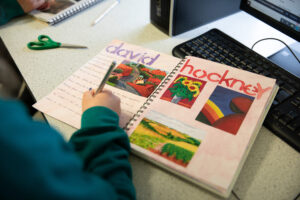
At Netherhall your Art book plays an integral part in the Art lessons. The sketchpad is where you record ideas, present studio work and project homework tasks. These build independent study skills, through observational drawing, research of personal ideas and artist studies.
YEAR 7
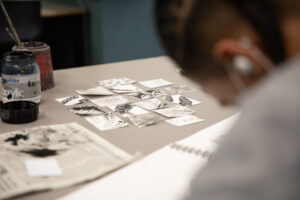
We welcome you in the first term to present yourself as a visual introduction. This creative journey allows the study of geometric shapes, colour theory, handling paint, collage, photography and design skills.
Each Art project starts with a drawing test to sharpen your observational drawing skills.
- Project 1: Is structured as a foundation course introducing the FORMAL ELEMENTS, inspired by the work of Kandinsky looking at Geometric Design and Colour Theory.
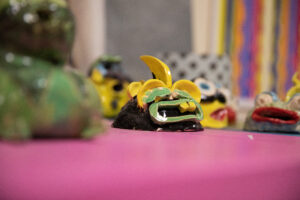
- Project 2: HEADS: 2D Design & Planning & 3D Sculpture/ Clay.
YEAR 8
- Project 1: FIGURES:Drawing, 2D, Mixed Media, Painting and Collage.
- Project 2: POP ART: Drawing, Design, Mixed Media, Collage, 3D Sculpture.
The Art courses in Year 7 & 8 prepare you for the start of GCSE in Year 9
YEAR 9
- TYPOGRAPHY and STREET ART: Drawing, Design, Text & Graffiti, Photography, Portraiture, Stencil Art, Spray Art, Digital Art, Mixed Media, Abstraction, Illustration, 3D Sculptural Site-specific Art.
Key Stage 4
In Key Stage 4 we follow Pearson/Edexcel Art & Design GCSE syllabus. The GCSE Art & Design course is two units: Coursework 60% Exam 40%
YEAR 10 – 11:
Your Art GCSE will start as a foundation Course. In the first term you will take part in tutor-led workshops that will introduce you to a full range of materials and creative approaches. This will give you the confidence to explore and develop skills in both 2D and 3D forms.
Drawing, Design, Sculpture, Fashion, Portraits, Textiles, Illustration, Graphics, Collage, Printing, Digital, Photography, Ceramics, Painting & Architecture.
In the second term you will work independently exploring a theme, visually demonstrating ideas and skills in handling media. You will record from sources and artists’ works building your sketchpad through to your final piece created in June of year 10. To start year 11, you will review and develop this work as your final piece for UNIT 1 in December. In January you begin work on the external exam question by preparing ideas in your sketchpad during Art lessons and with your teacher’s help. Your final piece will be produced in April as a 10-hour practical exam over two days. The year culminates in an Art exhibition as part of the Arts festival.
Key Stage 5
In Key Stage 5 we offer Art & Photography courses.
Art courses follow Pearson/Edexcel Art & Design A Level syllabus, we offer ART & Design and Fine Art courses. Photography follows The Welsh board Photography syllabus. The courses are two units: Coursework 60% Exam 40%
Art students work across any combination of disciplines including, Painting, Drawing, Mixed Media, Printmaking, Photography, Sculpture, Fine Art Illustration, Graphics, Textiles, Design and Craft.
Photography students cover Lens based image making, animation, Photoshop and Dark Room practice.
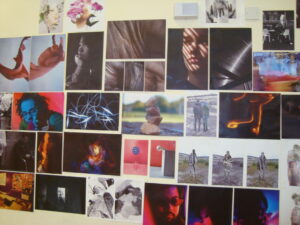
Art Clubs: We have various activities and special projects where students can explore their creativity, expand their knowledge and experience different media. These works build toward school events, such as the school play and the Arts festival.
Doodle Club is a weekly event run by our Artist in Residence.
Art Festival & Shows: At the end of the school year, we celebrate the achievements of all Art students alongside the GCSE & A Level Art & Photography students with an exhibition where we join forces with Drama and Music to create the Art Festival.
Galleries: Each year we visit several galleries both locally and further afield, giving the chance to experience Art beyond the studio. During these excursions we have direct contact with creative professionals such as Grayson Perry, Anthony Gormley and Quentin Blake. Our A Level students have previously experienced Art and its influence on the world, with trips abroad; visiting Berlin, Venice, Paris, Barcelona & New York.